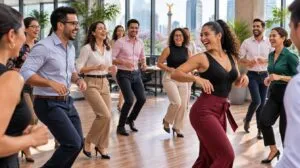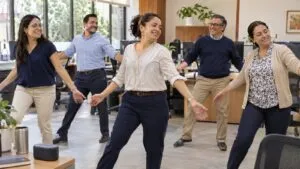

Active breaks at work are no longer unusual. Many companies we know invest in gyms, personal trainers, yoga classes and even physiotherapy sessions for their people. All of that adds up, and variety is good. But when we bring a dance break to an office, something different happens: the music starts, someone laughs, the IT guy gets into the cumbia and, in ten minutes, the atmosphere has changed.
In Mexico these breaks are known as “pausas activas” and are a common workplace practice. Since we started bringing these sessions to companies in Puebla, we’ve wondered what’s behind that change. We reviewed the research, and here we share what it says, without exaggerating, and how to apply it with your team.
What are active breaks?
They are short interruptions of the workday, five to ten minutes long, to move, stretch and change posture. In research they’re called micro-breaks: any interruption of a task lasting ten minutes or less. They can be stretching exercises, a short walk, breathing or, as we suggest, a simple dance sequence with music.
What science says about short breaks
In 2022, a team from the West University of Timișoara published in PLOS ONE a meta-analysis of 22 studies on micro-breaks. They found that breaks of ten minutes or less are associated with more vigor and less fatigue. The effect on performance was less clear overall, although slightly longer breaks helped more with routine or creative tasks.
Another study, published in 2016 in the International Journal of Behavioral Nutrition and Physical Activity, compared three office days with 30 sedentary adults: sitting all day, a 30-minute walk in the morning, or standing up for five minutes every hour. Both days with movement gave more energy, but only the five-minute breaks every hour also improved mood, reduced end-of-day tiredness and lowered cravings before lunch.
The lesson for any company: you don’t need an hour of exercise. Several short breaks spread across the day feel bigger than a single long one.
Why music changes the break
This is the difference from stretching in silence. In 2020, Psychological Bulletin published the largest analysis on music and exercise: 139 studies with more than 3,500 participants. Moving to music:
- Improves mood during the activity.
- Reduces perceived effort: the same movement feels lighter.
- Improves physical performance, especially with fast rhythms.
In an office this matters more than it seems. An active break nobody does is useless, and the hardest part is getting people to want to stand up. When the break feels easy and enjoyable, people join in, and come back next time.
Dancing together brings the team together
Music also does something the gym doesn’t: it synchronizes people. Researchers from the University of Oxford studied 264 young people in Brazil dancing in groups, with or without synchronized movements, and with more or less intensity. Synchronized dancing increased the feeling of closeness to the group and raised pain thresholds, an indirect indicator of endorphin release. The effect was greatest when energy and synchrony were combined.
It’s what we see in every session: moving to the same rhythm as the person next to you creates a bond, even between people who barely speak. That’s why a dance break also works as a team building activity.
What about the famous brain “reset”?
People who join our sessions describe it like this: “I went back to my desk with a clear head.” We want to be honest about what science says. Micro-break studies find clear effects on energy, mood and fatigue, but mixed results on immediate concentration. On dance and cognitive function, the strongest evidence comes from older adults: a review of 11 trials with more than 1,400 participants, published in Age and Ageing in 2021, found improvements in general cognition.
What we can explain is why it feels like a restart. Dancing demands something different from screen work: listening to the rhythm, remembering a short sequence, coordinating your body and watching others. It’s a complete change of channel. The body shakes off the lethargy of sitting and the mind leaves the pending email aside for a few minutes.
Dance, gym, yoga or physiotherapy: what each one offers
It’s not about choosing one. Each option plays a different role in a workplace wellbeing program:
| Option | What it does best | Where and how |
|---|---|---|
| Gym or trainer | Individual strength and fitness | Outside the office, in sportswear |
| Yoga | Flexibility, breathing and calm | Free room, mats |
| Physiotherapy | Preventing injuries and correcting posture | One-on-one care |
| Active break with dance | Movement, mood and team connection in a few minutes | In the office itself, in work clothes, no equipment |
Fun active breaks: a 10-minute routine with music
This is a simple version of what we do in companies. It works in office clothes and without physical contact:
- Minutes 1 and 2, wake up the body. With a calm song: shoulder, neck and wrist circles, and shifting weight from one foot to the other.
- Minutes 3 to 5, cumbia. The basic back step, first counting and then with the music. It’s the rhythm almost everyone in Mexico already carries in their body.
- Minutes 6 to 8, group salsa. Basic step in lines, everyone facing each other, with a simple turn at the end. This is where the laughter starts.
- Minutes 9 and 10, cool-down. Deep breathing and back and leg stretches before returning to the desk.
Repeating it two or three times a week, mid-morning or after lunch, is usually enough for it to become part of the team’s culture.
Active breaks and Mexico’s NOM-035
If your company operates in Mexico, the NOM-035-STPS-2018 standard requires workplaces to identify psychosocial risk factors, take measures to prevent them and promote a favorable organizational environment. It has been fully in force since October 23, 2020, and non-compliance can lead to fines of 250 to 5,000 UMA (Mexico’s official unit of measure for fines).
A dance break doesn’t replace the assessment the standard requires, but it can be part of the actions to improve the work environment and team relations. If you’re interested in the legal side of breaks, read our article on what Mexican law requires about active breaks.
Frequently asked questions
How often should we take active breaks?
The studies work with short, frequent breaks: for example, five minutes every hour. In practice, a guided break with music two or three times a week, plus short individual breaks, already makes a difference.
Does my team need to know how to dance?
No. We design each session for people with no experience, with steps anyone can follow from the first minute.
Can it be done in our office?
Yes. We come to your facilities in Puebla, Atlixco or Cholula, Mexico. All you need is a clear space and a speaker. Sessions can be led in Spanish or English.
How much does it cost?
We prepare a tailored quote in Mexican pesos (MXN) based on the number of people, frequency and format: recurring breaks, a team building session or an event.
Bring dance active breaks to your company
At Delirio we bring active breaks and corporate team building sessions to work teams, with music, simple steps and lots of energy. Message us on WhatsApp and we’ll put together a proposal for your team. Dance and be happy.
Sources
- Albulescu, P. et al. (2022). Give me a break! A systematic review and meta-analysis on the efficacy of micro-breaks for increasing well-being and performance. PLOS ONE. doi.org/10.1371/journal.pone.0272460
- Bergouignan, A. et al. (2016). Effect of frequent interruptions of prolonged sitting on self-perceived levels of energy, mood, food cravings and cognitive function. International Journal of Behavioral Nutrition and Physical Activity. doi.org/10.1186/s12966-016-0437-z
- Terry, P. C. et al. (2020). Effects of music in exercise and sport: A meta-analytic review. Psychological Bulletin, 146(2), 91–117. Study summary
- Tarr, B. et al. Synchrony and exertion during dance independently raise pain threshold and encourage social bonding. Biology Letters. Study summary (Phys.org)
- Hewston, P. et al. (2021). Effects of dance on cognitive function in older adults: a systematic review and meta-analysis. Age and Ageing, 50(4). Study summary
- IDC Online (2020). Por fin, NOM-035 en plena vigencia (in Spanish). idconline.mx