
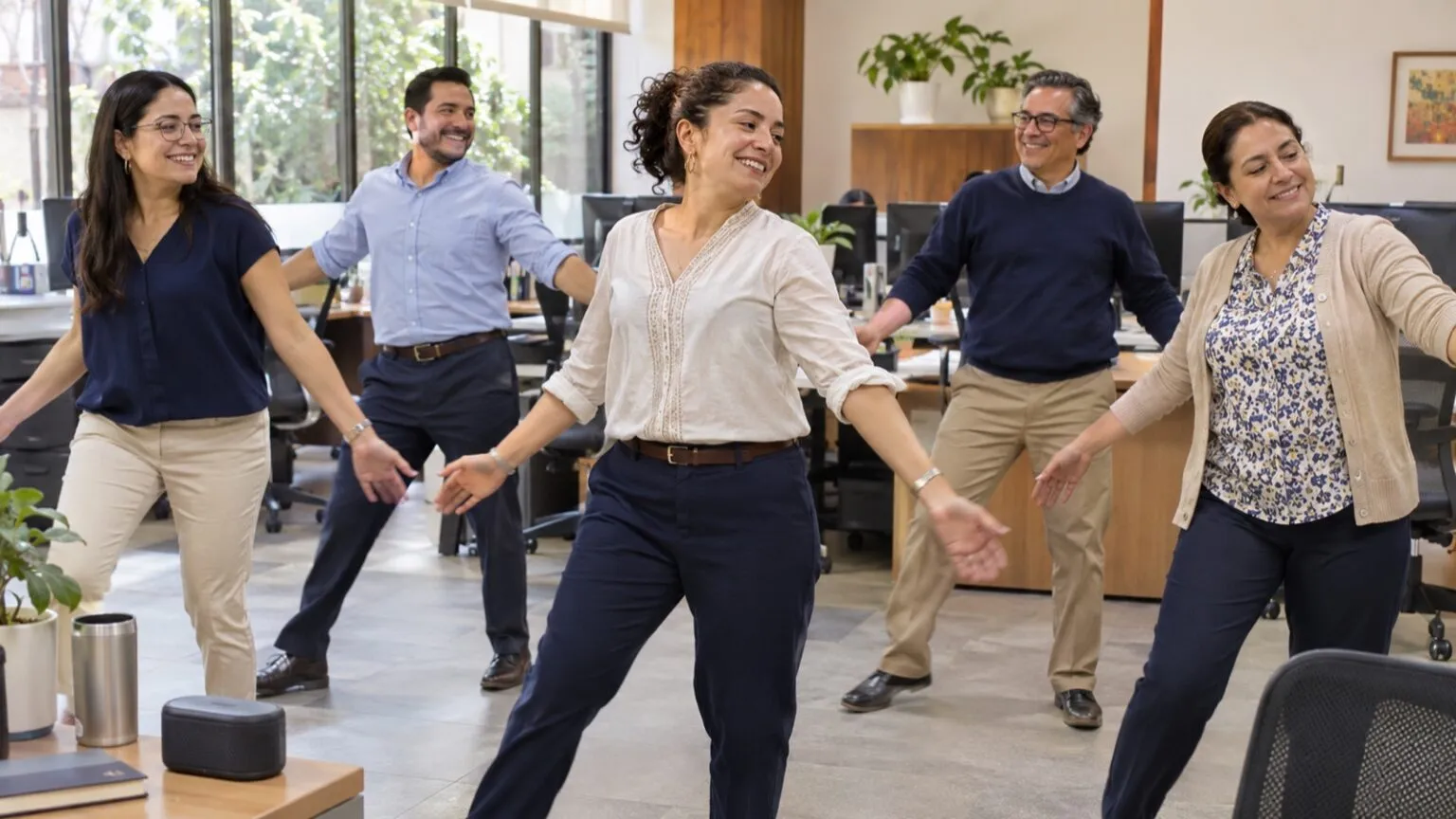
After several hours in front of a computer, an office can feel stuck in the same rhythm: emails, calls, to-dos and another meeting. People keep working, but they barely move or talk about anything beyond what’s urgent.
At Delirio we have also worked with people who spend much of their day in administrative roles. That’s why I like to propose a break that lets them move and share something pleasant: a simple sequence, a song and a few minutes of attention away from the screen.
This article is written for HR and safety teams at companies operating in Mexico, including international companies with offices here. Before talking about music, it’s worth clarifying what Mexican law requires and what we can contribute through dance.
Are active breaks mandatory in Mexico?
The answer depends on the job and the applicable regulation. The so-called “Ley Silla” (Chair Law) added to Mexico’s Federal Labor Law (Ley Federal del Trabajo) the right to periodic rest in chairs with backrests and a ban on forcing staff to remain standing for the whole workday. It covers services, retail and similar workplaces; in industry, the nature of the work is taken into account. You can check articles 132, section V, and 133, section XVII Bis, in the Federal Labor Law (in Spanish).
In addition, the STPS (Ministry of Labor) provisions for people who work standing up (in Spanish), published on July 17, 2025, include a program of active breaks based on a risk analysis, along with other preventive measures. The frequency is set from that analysis; there is no universal number of minutes for every job.
This doesn’t mean every office has a general obligation to hire dance sessions. For an administrative team that works seated, a break with music can be part of a wellbeing initiative, adapted to their tasks and needs. It’s up to the health and safety department to identify each workplace’s obligations. A Delirio session does not replace that assessment, legal rest periods or ergonomic measures. We are dance teachers, not lawyers, so check the specifics with your legal or safety advisor.
What a song adds to a movement break
A squat, a short walk or a change of posture can all have a place in a well-designed break. With music we can add another experience: listening to a beat, remembering a short sequence and coordinating it with other people.
In class I see how a simple cue changes the conversation. Suddenly, people who were focused on their own screens are trying to follow the same step. We don’t need difficult choreography or for anyone to “know how to dance” to get started.
Research also lets us look carefully at that social dimension. An experiment on synchronized movement and dance found favorable changes in participants’ sense of connection. It’s a research result, not proof that dancing at the office automatically reduces staff turnover or that it beats any other kind of break.
Our proposal is concrete: use rhythm as a guide and offer a shared, accessible and enjoyable moment within a workday that can be very repetitive.
How to organize a break with music
Before choosing the song, we review with the company the available space, the dynamics of each role, how people can take part and any adaptations needed. The activity should allow simple versions, standing or seated, and voluntary participation. No physical contact is needed and nobody has to go up front.
Here is an eight-minute example to discuss the format with your team; it’s not a mandatory duration or a routine suitable for everyone:
- First minute: switch activities. Leave the task at a safe stopping point, check the space and explain that there’s no test or dance contest.
- Two minutes of gentle movement. Start with comfortable arm and shoulder gestures and small weight shifts, with a seated option and without forcing range of motion.
- Three minutes with a song. Practice two or three easy moves and repeat them with the musical beat. Instructions should be clear and the volume low enough to hear them.
- One minute to share. Try a variation of the sequence or follow a group cue, without pushing anyone to compete or put themselves on display.
- Last minute: slow down. Close calmly and ask whether the experience felt comfortable before returning to work.
The music selection matters: a recognizable rhythm, lyrics suited to the setting and the group’s preferences. It’s also important that the department in charge adjusts the format to the team’s conditions. If a movement causes discomfort, stop and adapt it.
Office wellbeing deserves more than a one-off activity
Salary matters. So do how people are treated, workload, rest, autonomy and the chance to feel part of the team. Someone can have a competitive salary and still experience their workday with burnout or disconnection.
A pleasant break won’t fix poor leadership or an impossible workload on its own. But it can open a conversation: are we leaving room to rest? How heard do people feel? What is a normal day like in this office?
That’s how I’d like dance to come in: as an experience of togetherness and an opportunity to listen to the team. If it becomes another uncomfortable obligation, much of what we want to build is lost.
How much does it cost to replace someone on your team?
When someone leaves, the cost doesn’t end with posting a job opening. There are interviews, selection time, onboarding, training and hours of support from people who already know the role. There may also be pending work while the new person learns.
To start measuring it, the company can add up its own records: recruitment + selection + onboarding + training + support + transition impact. There’s no need to invent a savings percentage to recognize that the team’s day-to-day experience deserves attention.
If you pilot a breaks program, it’s worth watching voluntary participation, asking whether the format feels pleasant and checking whether it really fits into operations. That data can help improve it. Retention and replacement costs need a broader analysis; it wouldn’t be serious to credit their changes to a single song.
From a break to a team building experience
At Delirio we bring dance activities to companies’ facilities in Puebla, Atlixco and Cholula, Mexico, in Spanish or English. We can talk about a short break for an administrative team or a corporate team building experience with more time to connect. Quotes are in Mexican pesos (MXN).
Tell us how many people would take part, where they work and what you’d like to improve in how they get along. From there we’ll look at a possible format and availability. The idea is that, for a few minutes, the team can also meet away from their to-do lists. Message us on WhatsApp.
Want to know what science says and how to put together a routine with music? Read our guide to dance active breaks at work.